 |
ezEngine Release 26.9
|
|
ezEngine Release 26.9
|
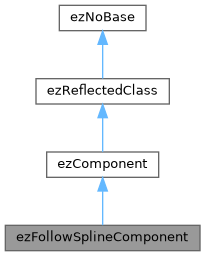
This component makes the ezGameObject, that it is attached to, move along a spline defined by an ezSplineComponent. More...
#include <FollowSplineComponent.h>
Public Member Functions | |
| virtual void | SerializeComponent (ezWorldWriter &ref_stream) const override |
| Override this to save the current state of the component to the given stream. | |
| virtual void | DeserializeComponent (ezWorldReader &ref_stream) override |
| Override this to load the current state of the component from the given stream. | |
| void | SetSplineObject (const char *szReference) |
| Sets the reference to the game object on which an ezSplineComponent should be attached. | |
| void | SetStartDistance (float fDistance) |
| Distance along the spline at which the ezFollowSplineComponent should start off. | |
| float | GetStartDistance () const |
| void | SetCurrentDistance (float fDistance) |
| Sets the current distance along the spline at which the ezFollowSplineComponent should be. | |
| float | GetCurrentDistance () const |
| void | SetDirectionForwards (bool bForwards) |
| Whether the component should move along the spline 'forwards' or 'backwards'. | |
| void | ToggleDirection () |
| Toggles the direction that it travels along the spline. | |
| bool | IsDirectionForwards () const |
| Whether the component currently moves 'forwards' along the spline. | |
| bool | IsRunning () const |
| Whether the component currently moves along the spline, at all. | |
| void | SetRunning (bool bRunning) |
| Whether to move along the spline or not. | |
 Public Member Functions inherited from ezComponent Public Member Functions inherited from ezComponent | |
| void | SetActiveFlag (bool bEnabled) |
| Sets the active flag of the component, which affects its active state. | |
| bool | GetActiveFlag () const |
| Checks whether the 'active flag' is set on this component. Note that this does not mean that the component is also 'active'. | |
| bool | IsActive () const |
| Checks whether this component is in an active state. | |
| bool | IsActiveAndInitialized () const |
| Returns whether this component is active and initialized. | |
| bool | IsActiveAndSimulating () const |
| Whether the component is currently active and simulation has been started as well. | |
| ezComponentManagerBase * | GetOwningManager () |
| Returns the corresponding manager for this component. | |
| const ezComponentManagerBase * | GetOwningManager () const |
| Returns the corresponding manager for this component. | |
| ezGameObject * | GetOwner () |
| Returns the owner game object if the component is attached to one or nullptr. | |
| const ezGameObject * | GetOwner () const |
| Returns the owner game object if the component is attached to one or nullptr. | |
| ezWorld * | GetWorld () |
| Returns the corresponding world for this component. | |
| const ezWorld * | GetWorld () const |
| Returns the corresponding world for this component. | |
| ezComponentHandle | GetHandle () const |
| Returns a handle to this component. | |
| ezUInt32 | GetUniqueID () const |
| Returns the unique id for this component. | |
| void | SetUniqueID (ezUInt32 uiUniqueID) |
| Sets the unique id for this component. | |
| void | EnsureInitialized () |
| Ensures that the component is initialized. Must only be called from another component's Initialize callback. | |
| void | EnsureSimulationStarted () |
| Ensures that the OnSimulationStarted method has been called. Must only be called from another component's OnSimulationStarted callback. | |
| EZ_ALWAYS_INLINE bool | SendMessage (ezMessage &ref_msg) |
| Sends a message to this component. | |
| EZ_ALWAYS_INLINE bool | SendMessage (ezMessage &ref_msg) const |
| void | PostMessage (const ezMessage &msg, ezTime delay=ezTime::MakeZero(), ezObjectMsgQueueType::Enum queueType=ezObjectMsgQueueType::NextFrame) const |
| Queues the message for the given phase. The message is processed after the given delay in the corresponding phase. | |
| virtual bool | HandlesMessage (const ezMessage &msg) const |
| Returns whether the given Message is handled by this component. | |
| void | SetUserFlag (ezUInt8 uiFlagIndex, bool bSet) |
| Be careful to check which flags may already be in use by base classes. | |
| bool | GetUserFlag (ezUInt8 uiFlagIndex) const |
| Retrieves a custom flag. Index must be between 0 and 7. | |
| void | SetCreatedByPrefab () |
| Adds ezObjectFlags::CreatedByPrefab to the component. See the flag for details. | |
| bool | WasCreatedByPrefab () const |
| Checks whether the ezObjectFlags::CreatedByPrefab flag is set on this component. | |
| void | DeleteComponent () |
| Deletes this component. Note that the component will be invalidated first and the actual deletion is postponed. | |
| Public Member Functions inherited from ezReflectedClass | |
| virtual const ezRTTI * | GetDynamicRTTI () const |
| bool | IsInstanceOf (const ezRTTI *pType) const |
| Returns whether the type of this instance is of the given type or derived from it. | |
| template<typename T > | |
| EZ_ALWAYS_INLINE bool | IsInstanceOf () const |
| Returns whether the type of this instance is of the given type or derived from it. | |
Public Attributes | |
| ezEnum< ezPropertyAnimMode > | m_Mode |
| [ property ] How the spline should be traversed. | |
| ezEnum< ezFollowSplineMode > | m_FollowMode |
| [ property ] How the transform of the follower should be affected by the spline. | |
| float | m_fSpeed = 1.0f |
| [ property ] How fast to move along the spline. | |
| float | m_fLookAhead = 0.0f |
| [ property ] How far along the spline to 'look ahead' to smooth the rotation. A small distance means rotations are very abrupt. | |
| float | m_fSmoothing = 0.5f |
| [ property ] How much to combine the current position with the new position. 0 to 1. At zero, the position follows the spline perfectly, but therefore also has very abrupt changes. With a lot of smoothing, the spline becomes very sluggish. | |
| float | m_fTiltAmount = 5.0f |
| [ property ] How much to tilt when turning. | |
| ezAngle | m_MaxTilt = ezAngle::MakeFromDegree(30.0f) |
| [ property ] The max tilt angle of the object. | |
Protected Member Functions | |
| virtual void | OnActivated () override |
| This method is called when the component gets activated. | |
| virtual void | OnSimulationStarted () override |
| This method is called once for active components, at the start of the next world update, but only when the world is simulated. | |
| void | Update (bool bForce=false) |
| const char * | DummyGetter () const |
| Protected Member Functions inherited from ezComponent | |
| ezComponent () | |
| Keep the constructor private or protected in derived classes, so it cannot be called manually. | |
| bool | IsDynamic () const |
| Returns whether this component is dynamic and thus can only be attached to dynamic game objects. | |
| virtual ezWorldModuleTypeId | GetTypeId () const =0 |
| virtual ezComponentMode::Enum | GetMode () const =0 |
| virtual void | Initialize () |
| Can be overridden for basic initialization that depends on a valid hierarchy and position. | |
| virtual void | Deinitialize () |
| This method is called before the component is destroyed. A derived type can override this method to do common de-initialization work. | |
| virtual void | OnDeactivated () |
| This method is called when the component gets deactivated. | |
| void | EnableUnhandledMessageHandler (bool enable) |
| By default disabled. Enable to have OnUnhandledMessage() called for every unhandled message. | |
| virtual bool | OnUnhandledMessage (ezMessage &msg, bool bWasPostedMsg) |
| When EnableUnhandledMessageHandler() was activated, this is called for all messages for which there is no dedicated message handler. | |
| virtual bool | OnUnhandledMessage (ezMessage &msg, bool bWasPostedMsg) const |
| When EnableUnhandledMessageHandler() was activated, this is called for all messages for which there is no dedicated message handler. | |
| bool | IsInitialized () const |
| bool | IsInitializing () const |
| bool | IsSimulationStarted () const |
Protected Attributes | |
| ezEventMessageSender< ezMsgAnimationReachedEnd > | m_ReachedEndEvent |
| ezGameObjectHandle | m_hSplineObject |
| float | m_fStartDistance = 0.0f |
| float | m_fCurrentDistance = 0.0f |
| bool | m_bLastStateValid = false |
| bool | m_bIsRunning = true |
| bool | m_bIsRunningForwards = true |
| ezVec3 | m_vLastPosition |
| ezVec3 | m_vLastForwardDir |
| ezVec3 | m_vLastUpDir |
| ezAngle | m_LastTiltAngle |
| Protected Attributes inherited from ezComponent | |
| const ezRTTI * | m_pMessageDispatchType = nullptr |
| Messages will be dispatched to this type. Default is what GetDynamicRTTI() returns, can be redirected if necessary. | |
Additional Inherited Members | |
| Static Public Member Functions inherited from ezNoBase | |
| static const ezRTTI * | GetStaticRTTI () |
This component makes the ezGameObject, that it is attached to, move along a spline defined by an ezSplineComponent.
Build a spline using an ezSplineComponent and ezSplineNodeComponents. Then attach an ezFollowSplineComponent to a free-standing ezGameObject and reference the object with the ezSplineComponent in it.
During simulation the ezFollowSplineComponent will now move and rotate its owner object such that it moves along the spline.
The start location of the 'hook' (the object with the ezFollowSplineComponent on it) may be anywhere. It will be teleported onto the spline. For many objects this is not a problem, but physically simulated objects may be very sensitive about this.
One option is to align the 'hook' perfectly with the start location. You can achieve this, using the "Keep Simulation Changes" feature of the editor (simulate with zero speed, press K, stop simulation). Another option is to instead delay the spawning of the object below the hook, by using an ezSpawnComponent next to the ezFollowSplineComponent, and thus have the payload spawn only after the hook has been placed properly.
|
overridevirtual |
Override this to load the current state of the component from the given stream.
The active state will be automatically serialized. The 'initialized' state is not serialized, all components will be initialized after creation, even if they were already in an initialized state when they were serialized.
Reimplemented from ezComponent.
|
inline |
Whether the component currently moves 'forwards' along the spline.
Note that if the 'speed' property is negative, moving 'forwards' along the spline still means that it effectively moves backwards.
|
overrideprotectedvirtual |
This method is called when the component gets activated.
By default a component is active, but it can be created in an inactive state. In such a case OnActivated() is only called once a component is activated. If a component gets switched between active and inactive at runtime, OnActivated() and OnDeactivated() are called accordingly. In contrast Initialize() and Deinitialize() are only ever called once.
Reimplemented from ezComponent.
|
overrideprotectedvirtual |
This method is called once for active components, at the start of the next world update, but only when the world is simulated.
This is the one preferred method to setup typical game logic. In a pure game environment there is no practical difference between OnActivated() and OnSimulationStarted(), as OnSimulationStarted() will be called right after OnActivated().
However, when a scene is open inside the editor, there is an important difference: OnActivated() is called once the component was created. OnSimulationStarted() is only called once the game simulation is started inside the editor. As an example, if a component starts a sound in OnActivated(), that sound will play right after the scene has been loaded into the editor. If instead the sound gets started in OnSimulationStarted(), it will only play once the user starts the game mode inside the editor.
Additionally, OnSimulationStarted() is only executed once, even if the ezWorld pauses and resumes world simulation multiple times. However, note that it will be called again after the component has been deactivated and is activated again.
Reimplemented from ezComponent.
|
overridevirtual |
Override this to save the current state of the component to the given stream.
Reimplemented from ezComponent.
 1.9.8
1.9.8