 |
ezEngine Release 26.9
|
|
ezEngine Release 26.9
|
#include <RenderGraph.h>
Public Member Functions | |
| ezGALDevice * | GetDevice () const |
| const ezString & | GetGraphName () const |
| Returns the immutable name assigned at creation. | |
| void | SetUserName (ezStringView sName) |
| Sets the user name that can be changed at any time. | |
| const ezString & | GetUserName () const |
| void | SetUserData (ezReflectedClass *pUserData) |
User data is accessible during execution callbacks via ctx.GetUserData<T>(). | |
| ezReflectedClass * | GetUserData () const |
Transient Resource Creation | |
| ezRenderGraphTextureHandle | CreateTexture (const ezGALTextureCreationDescription &desc) |
| Create a transient texture. The GPU resource is allocated or aliased from a pool during compilation. There is no need to set any flags on the texture. Whenever a pass operates on a texture its flags are extended to support that operation. | |
| ezRenderGraphBufferHandle | CreateBuffer (const ezGALBufferCreationDescription &desc) |
| Create a transient buffer. The GPU resource is allocated or aliased from a pool during compilation. There is no need to set any flags on the buffer. Whenever a pass operates on a buffer its flags are extended to support that operation. | |
Resource Queries | |
| const ezGALTextureCreationDescription & | GetTextureDesc (ezRenderGraphTextureHandle hTexture) const |
| Returns the creation description of a transient or imported texture. Note that this reference is not stable and can become invalid when new textures are added to the graph so it is best to store a copy of the returned value. | |
| const ezGALBufferCreationDescription & | GetBufferDesc (ezRenderGraphBufferHandle hBuffer) const |
| Returns the creation description of a transient or imported buffer. Note that this reference is not stable and can become invalid when new buffers are added to the graph so it is best to store a copy of the returned value. | |
Import External Resources | |
| ezRenderGraphTextureHandle | ImportTexture (ezGALTextureHandle hTexture, ezBitflags< ezGALResourceState > access=ezGALResourceState::Unknown, ezBitflags< ezGALShaderStageFlags > stage=ezGALShaderStageFlags::Auto) |
Import an existing GPU texture into the graph, returning a graph handle so it can be used inside the graph. You can optionally set access and stage to force a barrier on the imported resource at the start of the graph. | |
| ezRenderGraphBufferHandle | ImportBuffer (ezGALBufferHandle hBuffer, ezBitflags< ezGALResourceState > access=ezGALResourceState::Unknown, ezBitflags< ezGALShaderStageFlags > stage=ezGALShaderStageFlags::Auto) |
Import an existing GPU buffer into the graph, returning a graph handle so it can be used inside the graph. You can optionally set access and stage to force a barrier on the imported resource at the start of the graph. | |
| ezStatus | ReplaceImportedTexture (ezRenderGraphTextureHandle hGraphTexture, ezGALTextureHandle hNewTexture) |
Use to replace a graph texture with an actual GPU resource. The hNewTexture must not be already imported into the graph. Mainly used when graphs are built greedily and the target swachchain image is not clear at which point it fints into the pipeline. Thus, the graph can be built entirely with transient graph textures and only at the end the replacement can be done. If this call failed the given texture does not fulfil the requirements made to the graph texture. | |
Pass Creation | |
| ezRenderGraphPassBuilder | AddGraphicsPass (ezStringView sName) |
| Add a graphics pass. Returns a builder through which resource accesses and the execution callback must be declared before compilation. | |
| ezRenderGraphPassBuilder | AddComputePass (ezStringView sName) |
| Add a compute pass. | |
| ezRenderGraphPassBuilder | AddTransferPass (ezStringView sName) |
| Add a transfer pass. | |
| void | PushMarker (ezStringView sMarker) |
| Insert a debug marker that will be pushed during execution at the/ current recording position (before the next pass). | |
| void | PopMarker () |
| Insert a pop-marker at the current recording position. | |
 Public Member Functions inherited from ezRefCounted Public Member Functions inherited from ezRefCounted | |
| virtual | ~ezRefCounted ()=default |
| Adds a virtual destructor. | |
| Public Member Functions inherited from ezRefCountingImpl | |
| ezRefCountingImpl ()=default | |
| Constructor. | |
| ezRefCountingImpl (const ezRefCountingImpl &rhs) | |
| void | operator= (const ezRefCountingImpl &rhs) |
| ezInt32 | AddRef () const |
| Increments the reference counter. Returns the new reference count. | |
| ezInt32 | ReleaseRef () const |
| Decrements the reference counter. Returns the new reference count. | |
| bool | IsReferenced () const |
| Returns true if the reference count is greater than 0, false otherwise. | |
| ezInt32 | GetRefCount () const |
| Returns the current reference count. | |
Compilation & Execution | |
| class | ezRenderGraphManager |
| class | ezRenderGraphPassBuilder |
| void | Reset () |
| Clear all declared passes and resources so the graph can be rebuilt. This is done automatically for enqueued graphs at the end of each frame, but should be called regardless every time you intent to record into the graph. | |
| ezResult | ValidateImportedResources () const |
| Checks that all imported textures and buffers still exist on the device. Call before registering the graph each frame to detect stale resources. | |
| ezResult | Compile () |
| Compile the graph: cull unused passes, allocate and alias transient resources. After this call, no new passes can be added until the graph is reset. | |
| void | ComputeBarriers (ezGALResourceStateTracker &ref_tracker, ezArrayPtr< ezRenderGraphPassObserver * > observers={}) |
| Compute texture and buffer barriers for each pass based on resource state tracking. | |
| void | Execute (ezRenderGraphContext &ref_ctx, ezArrayPtr< ezRenderGraphPassObserver * > observers={}) |
| Execute all passes in compiled order. | |
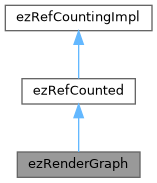
Render graph usable for a single frame. Contains passes that declare transient resource dependencies. After all passes are added, the graph is compiled to cull unused passes, allocate and alias transient resources, and compute barrier placement, then executed. Passes are always executed in declaration order.
The graph object is designed to persist across the lifetime of the program. Every frame you want to use the graph, call Reset() before re-declaring passes. Note that only one ezRenderGraphPassBuilder can exist at any time so calls to Add*Pass must be scoped individually. Finally, call ezRenderGraphManager::EnqueueRenderGraph to submit the graph for execution this frame.
 1.9.8
1.9.8